Procrastination
Understanding procrastination
Fact #1: It’s rarely about time management
Procrastination is more about unrealistic expectations, avoidance, coping with stress or fear of failure.
Fact #2: It’s about coping
Procrastination is an attempt to cope with external pressures and negative internal experiences. So it feels adaptive in the moment.
Fact #3: It leads to stress
Procrastination is linked with higher stress levels, illness and lower academic performance among college students.
Fact #4: It can create bad habits
Believing you get positive outcomes from last‑minute work or “I only work well under pressure” can fuel the habit.
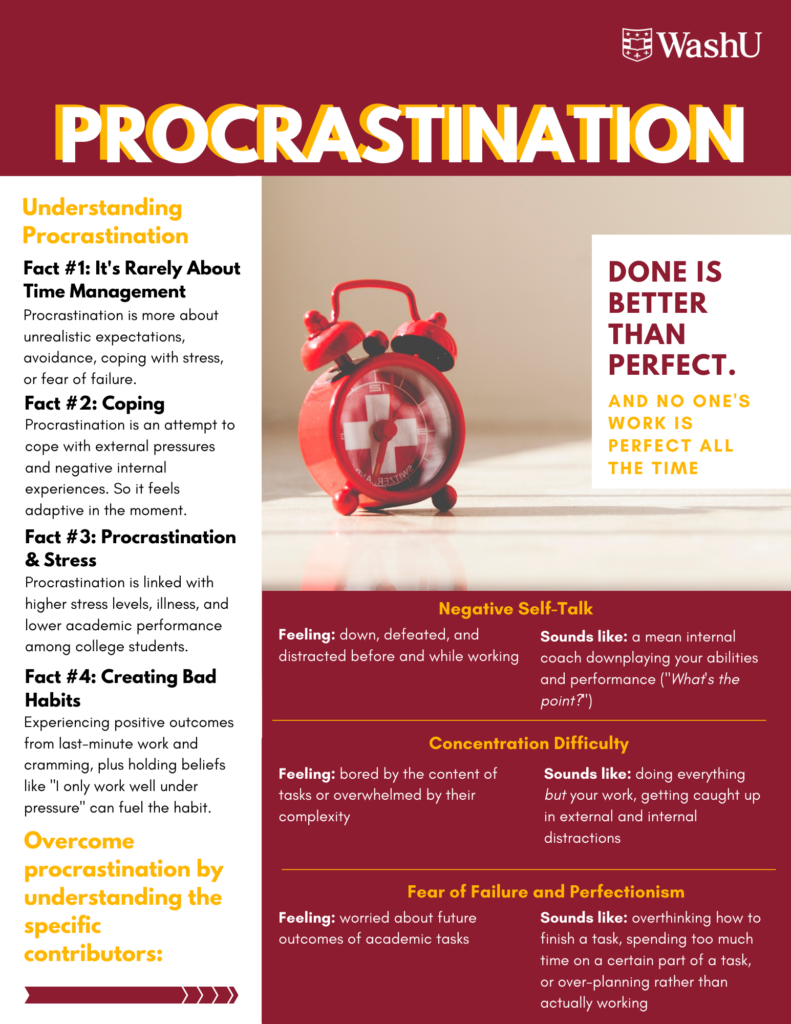
Done is better than perfect, and no one’s work is perfect all the time.
Overcoming procrastination
Understanding specific contributors to procrastination can help you to overcome it
Negative self-talk
Feeling: down, defeated and distracted before and while working.
Sounds like: a mean internal coach downplaying our abilities and performance (“What’s the point?”)
Concentration difficulty
Feeling: bored by the content of tasks or overwhelmed by their complexity
Sounds like: doing everything but your work, getting caught up in external and internal distractions
Fear of failure and perfectionism
Feeling: worried about future outcomes of academic tasks
Sounds like: overthinking how to finish a task, spending too much time on a certain part of a task, or over-planning rather than actually working
Creating conditions for success
Create an environment and circumstances that promote productivity
- Find the time of day when you have the most focus and energy. Do your hardest tasks then.
- Cut out external distractions (noise, people, lighting).
- Use “Do Not Disturb” on your phone.
- Schedule a reward after each work block (e.g., walk, chat with a friend).
Address emotional barriers
- Make a stressful and demanding task more doable by breaking it into smaller chunks.
- Reframe procrastination as avoidance: when you avoid a task, you might be making it more stressful.
- Identify each action as a choice point. What behavior will you engage in next? Work or procrastination?
Time to act!
- Just start! Perfectionism can be paralyzing. Strive for progress instead.
- It’s better to be a perfectionist editor than a perfectionist creator.
- Set limits on how long you’ll work. Rather than schedule an entire day, give yourself time for work and play.
Resources
Student Health Center – Danforth Campus
Counseling & Psychological Services (CCPS)